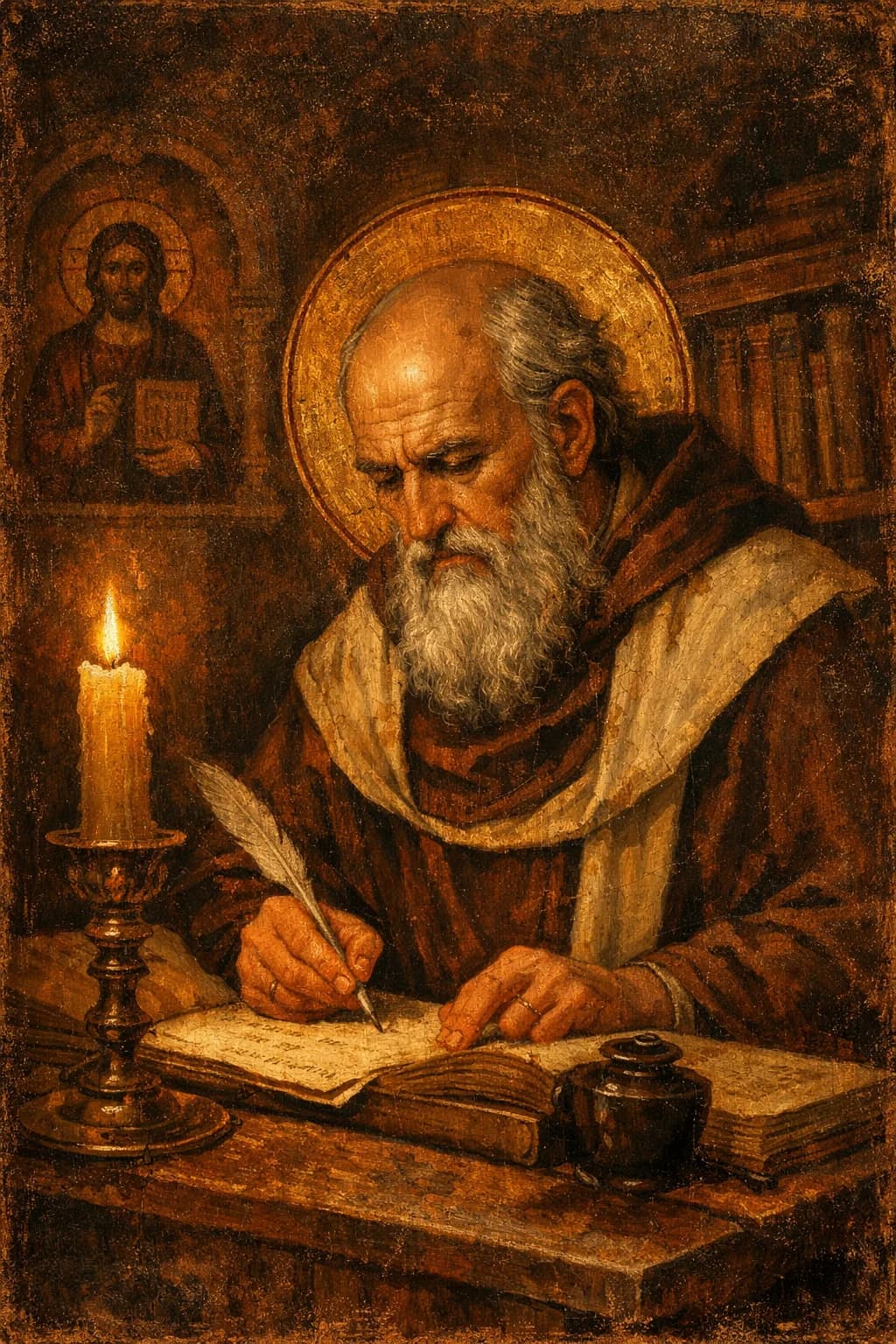
What the Great Theologians Taught on Key Doctrines
From Justin Martyr to John Wesley. Explore the teachings of the most influential theologians in Christian history, organized by doctrine and era, with primary source quotations for each figure.
Who Are the Church Fathers and Reformers?
The church fathers are the theologians, bishops, and writers of the early Christian centuries whose teachings shaped the doctrines, creeds, and practices of the faith. They include figures like Clement of Rome (first century), Ignatius of Antioch, Justin Martyr, Irenaeus, Tertullian, Origen, Athanasius, the Cappadocian Fathers (Basil, Gregory of Nazianzus, Gregory of Nyssa), John Chrysostom, Jerome, and Augustine. Their writings -- letters, treatises, homilies, and commentaries -- are the primary record of how the early church understood and taught the scriptures.
The Reformers of the sixteenth and seventeenth centuries -- Martin Luther, John Calvin, and Huldrych Zwingli -- challenged the medieval church's practices and theology, returning to the principle of sola scriptura (scripture alone) as the final authority. Their commentaries, confessions, and theological works reshaped Western Christianity and gave rise to the Protestant traditions. Later figures like John Wesley continued this tradition of rigorous biblical exposition and systematic theology.
The Church Fathers & Reformers tool organizes these theologians by era and presents their teachings on key doctrines: the Trinity, the person of Christ, salvation, the church, the sacraments, scripture, sin, grace, and the end times. For each doctrine, you can see what the major figures taught, read primary source quotations in translation, and understand how their views influenced the development of Christian theology over two millennia.
This tool is designed for anyone who wants to understand what the historic church actually taught -- not secondhand summaries, but the words of theologians themselves. Whether you are tracing the development of Trinitarian doctrine from Nicaea to Constantinople, comparing Augustine's and Calvin's views on predestination, or reading Anselm on why God became man, the Church Fathers & Reformers tool provides structured access to the theological tradition that underlies all of modern Christianity.
How It Works
Browse by theologian or doctrine
Explore the collection by individual theologian (organized by era) or by doctrinal topic. Each view shows the relevant figures and their positions on the selected doctrine.
Read primary source quotations
Each entry includes direct quotations from the theologian's writings, presented in English translation with source attribution so you can read their actual words on the topic.
Compare across eras
See how a doctrine developed over time by comparing what the early fathers, medieval theologians, Reformers, and later Protestant teachers wrote about the same topic.
Key Features
Theologians Across Two Millennia
Coverage spanning from the Apostolic Fathers of the first century through the Reformers to nineteenth-century preachers, with biographical context and historical setting for each figure.
Doctrine-Centered Organization
Teachings organized by core doctrines -- Trinity, Christology, salvation, grace, scripture, the church, and more -- so you can trace how each doctrine was understood and debated across centuries.
Primary Source Quotations
Direct quotations from the theologians' own writings, translated into English with source citations, so you can engage with their actual arguments rather than secondhand summaries.
Cross-Era Comparison
Compare what different theologians from different eras taught on the same doctrine, revealing both the continuity and the development of Christian theological thought over time.
A real teaching on The Trinity from Augustine:
Augustine on The Trinity
The Trinity is one God, not that the Father is the same person as the Son and the Holy Spirit, but that the Father is the Father, the Son is the Son, and the Holy Spirit is the Holy Spirit, and this Trinity is one God. — De Trinitate, Book V (354-430 AD)
Why This Matters
Augustine's formulation resolved the central paradox of Christian faith: God is one in essence yet three in person. Rather than collapsing the persons into one another, he preserved both monotheism and the real distinctions revealed in Scripture—the Father who begets, the Son who is begotten, and the Spirit who proceeds. This became the standard Western articulation of the Trinity.
Frequently Asked Questions
Who are the most important church fathers?
The most influential church fathers include Ignatius of Antioch, Justin Martyr, Irenaeus, Tertullian, Origen, Athanasius, Basil of Caesarea, Gregory of Nazianzus, Gregory of Nyssa, John Chrysostom, Jerome, and Augustine. Each made lasting contributions to Christian theology: Athanasius defended the deity of Christ at Nicaea, Augustine shaped Western theology on grace and sin, Jerome produced the Vulgate translation, and Chrysostom's homilies remain models of biblical exposition.
What did the Reformers believe differently from the Catholic Church?
The Protestant Reformers emphasized five key principles (the 'five solas'): sola scriptura (scripture alone as the final authority), sola fide (justification by faith alone), sola gratia (salvation by grace alone), solus Christus (through Christ alone), and soli Deo gloria (to God alone be the glory). They challenged the authority of the papacy, the sale of indulgences, the doctrine of purgatory, and various sacramental practices. The Church Fathers & Reformers tool shows these positions in the Reformers' own words.
Are the quotations from original sources?
Yes. The quotations are drawn from the theologians' published writings -- letters, treatises, commentaries, sermons, and confessions -- presented in English translation. Each quotation includes a source citation (work title, chapter, or section) so you can locate the full text in standard editions or online archives if you want to read further.
Does this tool cover Eastern Orthodox theologians?
Yes. The early church fathers included in the tool -- particularly the Cappadocian Fathers, John Chrysostom, and others from the Eastern tradition -- are foundational to both Eastern Orthodox and Western Christianity. The tool covers the period before the Great Schism of 1054 comprehensively and includes the most significant Eastern voices in the theological tradition.
Start Using Church Fathers & Reformers
Full access to Church Fathers & Reformers and 57+ other study tools.
Starting at $7/mo or $59/yr
Already have an account? Sign in