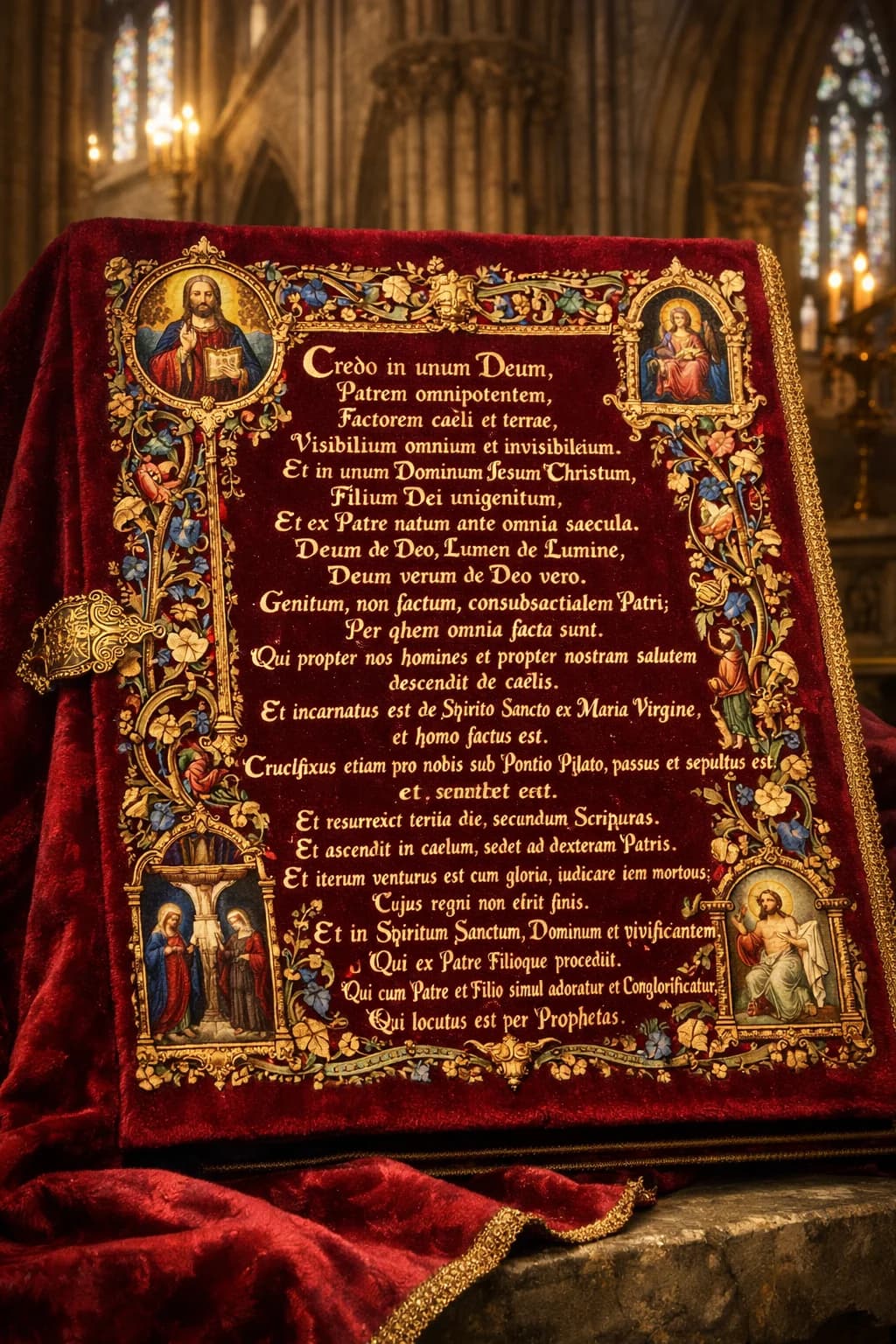
The Historic Statements of Christian Faith
From the Apostles' Creed to the Westminster Confession. Read key excerpts and selected articles from the creeds, confessions, and catechisms that have defined Christian orthodoxy for centuries, with historical context and scripture references.
What Are Creeds and Confessions?
Creeds and confessions are formal statements of Christian belief adopted by churches and councils throughout history. A creed (from the Latin 'credo,' meaning 'I believe') is a concise summary of essential doctrine, typically recited in worship. A confession is a more detailed doctrinal statement, often produced by a particular church or tradition to define its beliefs on a range of theological topics. Together, creeds and confessions form the doctrinal backbone of historic Christianity.
The earliest and most universally recognized creeds are the Apostles' Creed (which developed in its current form by the eighth century from earlier baptismal creeds) and the Nicene Creed (formulated at the Council of Nicaea in 325 AD and expanded at the Council of Constantinople in 381 AD). The Chalcedonian Definition (451 AD) clarified the doctrine of Christ's two natures. The Athanasian Creed provided a detailed statement on the Trinity. These ecumenical creeds are accepted by virtually all branches of Christianity -- Catholic, Orthodox, and Protestant.
The Reformation produced a wealth of confessional documents as Protestant churches defined their beliefs in distinction from Rome and from each other. The Augsburg Confession (1530) articulated Lutheran theology. The Heidelberg Catechism (1563) became central to the Reformed tradition in Germany and the Netherlands. The Westminster Confession of Faith and its Shorter and Larger Catechisms (1646-1647) defined Presbyterian theology. The London Baptist Confession of Faith (1689) adapted Westminster for Baptist convictions. Each of these documents remains in active use today as a teaching and doctrinal standard.
Gospel Daily presents key excerpts and selected articles from these creeds and confessions with historical context, scripture references for each article or section, and notes on the theological issues each document was addressing. You can read the selected excerpts, browse by article or chapter, or compare how different confessions address the same doctrine. This tool is designed for anyone who wants to understand what the historic church has believed and confessed across the centuries.
How It Works
Browse the collection
Explore creeds and confessions organized chronologically, from the early ecumenical creeds through Reformation-era confessions to later doctrinal statements. Each document shows its date, tradition, and purpose.
Read key excerpts
Open any creed or confession to read its key articles and chapters, with scripture references linked to each section so you can see the biblical basis for each doctrinal statement.
Study historical context
Each document includes background on the council, assembly, or theologians who produced it, the theological controversies it addressed, and its role in the tradition that adopted it.
Key Features
Key Excerpts from Historic Confessions
Selected articles and chapters from the Apostles' Creed, Nicene Creed, Chalcedonian Definition, Augsburg Confession, Heidelberg Catechism, Westminster Confession, London Baptist Confession, and more.
Scripture References
Each article, chapter, or section of every confession is linked to the scripture passages that support it, showing the biblical foundation for each doctrinal claim.
Doctrinal Comparison
Compare how different confessions from different traditions address the same doctrines -- justification, the sacraments, the church, scripture -- to see both agreement and distinction.
Historical Context
Background for each document including the council or assembly that produced it, the theological controversies at stake, and how the document has been used in its tradition over the centuries.
A real creed this tool provides:
Apostles' Creed (~140-700 AD)
I believe in God, the Father almighty, creator of heaven and earth. I believe in Jesus Christ, his only Son, our Lord, who was conceived by the Holy Spirit, born of the Virgin Mary, suffered under Pontius Pilate, was crucified, died, and was buried; he descended to the dead. On the third day he rose again; he ascended into heaven, he is seated at the right hand of the Father, and he will come to judge the living and the dead. I believe in the Holy Spirit, the holy catholic Church, the communion of saints, the forgiveness of sins, the resurrection of the body, and the life everlasting. Amen.
Historical Context
Developed from early baptismal creeds used in Rome. The earliest written version dates to around 215 AD in Hippolytus' Apostolic Tradition. Reached its current form by the 8th century. The Apostles' Creed remains the most widely used Christian creed, recited in worship by Catholic, Anglican, Lutheran, Methodist, Presbyterian, and many other churches.
Scripture Foundation
Matthew 28:19 (Trinitarian formula); 1 Corinthians 15:3-8 (death and resurrection); Romans 10:9 (confession of Christ); Acts 1:9-11 (ascension and return).
Frequently Asked Questions
What is the Apostles' Creed?
The Apostles' Creed is a statement of Christian belief that developed from early baptismal creeds used in the Roman church. Its current form dates to about the eighth century, though earlier versions existed by the second century. It summarizes core Christian beliefs about God the Father, Jesus Christ (His birth, death, resurrection, and return), the Holy Spirit, the church, forgiveness, and eternal life. It is recited in worship by Catholic, Anglican, Lutheran, Methodist, Presbyterian, and many other churches.
What is the Nicene Creed?
The Nicene Creed was formulated at the Council of Nicaea in 325 AD to combat the Arian heresy, which denied the full deity of Christ. It was expanded at the Council of Constantinople in 381 AD to include fuller statements about the Holy Spirit. The Nicene Creed affirms that Christ is 'of one substance with the Father' (homoousios) and is the most widely accepted creed in Christendom, used by Catholic, Orthodox, and most Protestant churches.
What is the Westminster Confession of Faith?
The Westminster Confession of Faith was produced by the Westminster Assembly of divines (theologians) meeting in London from 1643 to 1649. It is a comprehensive statement of Reformed (Calvinist) theology covering 33 chapters on topics from scripture and God to the last judgment. It became the doctrinal standard for Presbyterian churches worldwide and influenced the London Baptist Confession and other Reformed documents. It is still the subordinate standard of faith for many Presbyterian denominations.
Why do creeds and confessions matter today?
Creeds and confessions serve several purposes: they summarize essential Christian doctrine in concise form, they connect modern believers to the faith of the historic church, they provide a standard for teaching and doctrinal accountability, and they help Christians articulate what they believe. Even in traditions that do not formally subscribe to confessions, these documents represent the consensus of centuries of careful biblical and theological reflection.
Do all Christians agree on these creeds?
The ecumenical creeds (Apostles', Nicene, Chalcedonian) are accepted by the vast majority of Christian traditions -- Catholic, Orthodox, and Protestant. The Reformation-era confessions represent specific traditions: the Augsburg Confession is Lutheran, the Heidelberg Catechism is Reformed, the Westminster Confession is Presbyterian, and so on. Christians from different traditions may not subscribe to every confession, but the ecumenical creeds represent the broadest consensus in Christian history.
Start Using Creeds & Confessions
Full access to Creeds & Confessions and 57+ other study tools.
Starting at $7/mo or $59/yr
Already have an account? Sign in