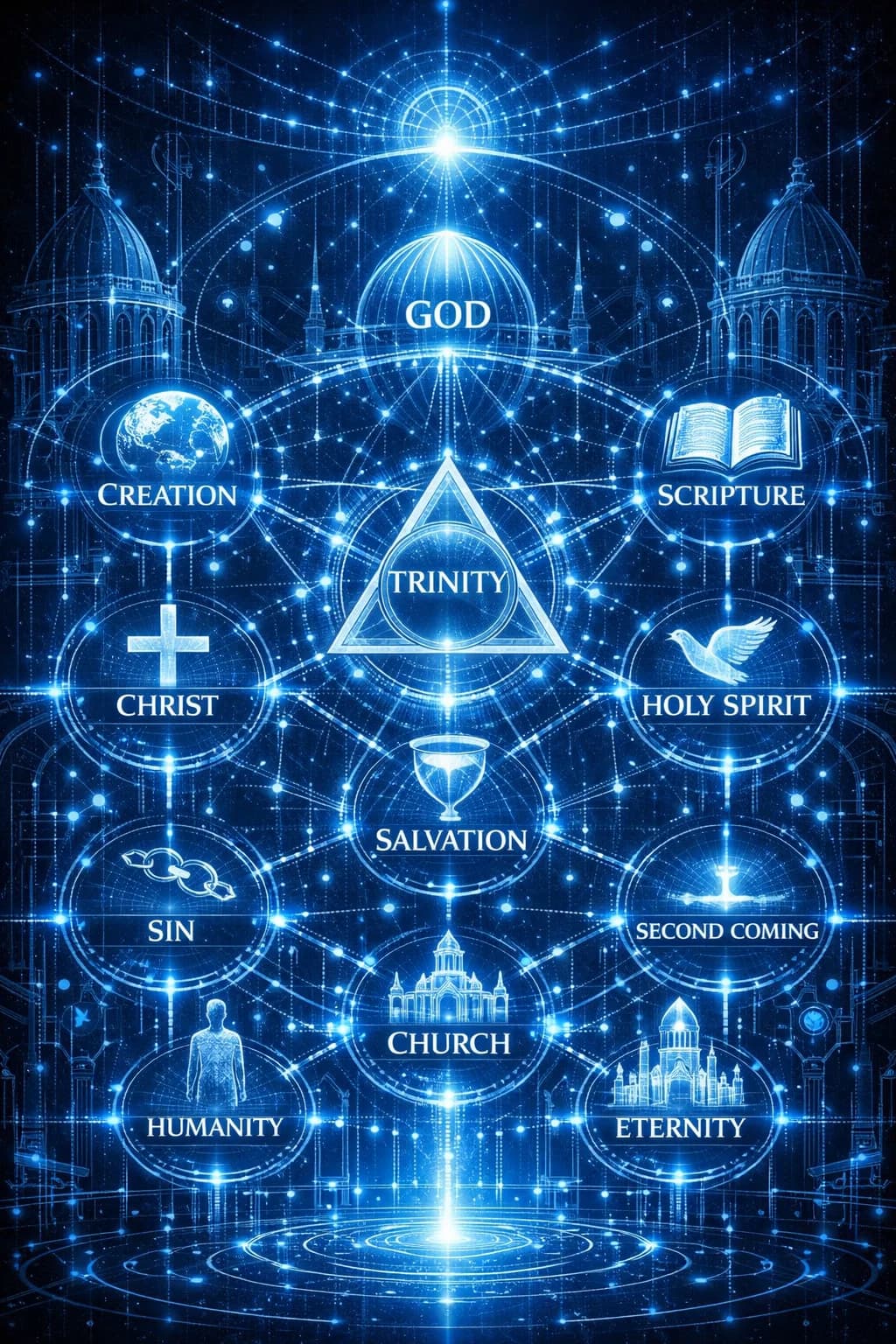
Trace Doctrine Across Old and New Testaments of Scripture
See how every major doctrine weaves through the Old and New Testaments -- gaining depth and clarity as progressive revelation unfolds God's plan.
What Is Doctrinal DNA?
Doctrinal DNA is a tool that maps how individual doctrines appear across the Old and New Testaments. Just as biological DNA contains strands that encode the instructions for life, the scriptures contain doctrinal strands -- recurring teachings that appear in different forms across different books and dispensations, all encoding the same eternal truths. Doctrinal DNA makes these strands visible by showing you, for any given doctrine, exactly where it appears in each volume, what its key references are, and how the teaching develops over time.
The Bible spans thousands of years of prophetic writing, from the earliest patriarchs through the apostolic era. This means that any doctrine can be traced across multiple authors, books, and dispensations. The doctrine of baptism, for example, appears in the law of Moses, in the teachings of Jesus, in the letters of Paul, and in the writings of Peter. Each book adds a strand of understanding that contributes to the full picture.
The Doctrinal DNA tool organizes doctrines into categories -- Plan, Christology, Ordinance, Covenant, Eschatology, and Moral -- so you can explore by theological theme. When you select a doctrine, you see its strands displayed by book, each with key references, a summary of how the doctrine is taught in that section, and a characteristic key phrase that captures the essence of the teaching. Color-coded indicators make it easy to see at a glance which books contribute to each doctrine.
Two synthesis sections tie the analysis together. The 'Connections Across Volumes' section explains how the different strands relate to each other, showing the threads that unite teachings separated by centuries and continents. The 'Progressive Revelation' section traces how the doctrine has been revealed incrementally over time, with each dispensation adding clarity and depth. Together, these sections demonstrate one of the central claims of Christian tradition: that God's truth is consistent across all ages but is revealed progressively as His children are prepared to receive it.
How It Works
Browse or search doctrines
Explore doctrines by category -- Plan, Christology, Ordinance, Covenant, Eschatology, or Moral -- or search by keyword to find a specific teaching.
View strands by volume
See how the selected doctrine appears in each volume of scripture, with key references, a summary, and a representative key phrase for each strand.
Read the synthesis
Review the connections across volumes and the progressive revelation analysis to understand how the doctrine develops across dispensations.
Key Features
Volume-by-Volume Strand Analysis
Each doctrine is broken down by volume, showing key references, summaries, and characteristic phrases that reveal how the teaching appears in each book.
Doctrinal Category Filtering
Browse doctrines organized into six theological categories: Plan, Christology, Ordinance, Covenant, Eschatology, and Moral teachings.
Progressive Revelation Tracing
See how each doctrine was revealed incrementally across dispensations, with each volume adding depth and clarity to the teaching.
Cross-Volume Connection Analysis
Read synthesis explanations that show how doctrinal strands in different volumes connect to each other, revealing the unity of God's revealed word.
A sample doctrine this tool produces, tracing the doctrine of Love and Compassion across the Testaments:
Old Testament — The Foundation
In Deuteronomy 6:5, Moses commands Israel: "Thou shalt love the Lord thy God with all thine heart, and with all thy soul, and with all thy might." This Shema establishes love as the supreme obligation toward God. Leviticus 19:18 extends this: "Thou shalt love thy neighbour as thyself." The prophet Micah synthesizes this in 6:8: "He hath shewed thee, O man, what is good; and what doth the Lord require of thee, but to do justly, and to love mercy, and to walk humbly with thy God?" These Old Testament passages declare love as the central ethical command—love for God and love for neighbor as the core of righteous living.
New Testament — The Fulfillment
Jesus identifies Himself as the embodiment and fulfillment of this command. Matthew 22:37-39 records: "Jesus said unto him, Thou shalt love the Lord thy God with all thy heart, and with all thy soul, and with all thy mind. This is the first and great commandment. And the second is like unto it, Thou shalt love thy neighbour as thyself." John 13:34-35 reveals that Christ's love becomes the pattern: "A new commandment I give unto you, That ye love one another; as I have loved you, that ye also love one another." The very essence of God is love—1 John 4:8 declares, "God is love."
Connections Across Volumes
The Old Testament's command to love God and neighbor is not abandoned in the New Testament but deepened and personalized. Jesus does not introduce a new ethic but fulfills the ancient commands by embodying them perfectly and empowering believers through the Spirit to love as He loves. The compassion commanded in Micah is demonstrated supremely in Christ's sacrifice.
Progressive Revelation
Love and compassion are revealed first as commands in the law, then deepened in the Psalms and Prophets as the interpreter of all law. Finally, in the New Testament, love is revealed as the very nature of God—not merely what He commands but who He is. The progression moves from external commandment to internal transformation by the Spirit, making love not a duty imposed from outside but a disposition flowing from union with God's own character.
Frequently Asked Questions
What is Doctrinal DNA?
Doctrinal DNA is a scripture study tool that maps how individual doctrines appear across the Old and New Testaments. For any selected doctrine, it shows the key references, summary, and characteristic key phrase in each volume where the doctrine appears, along with synthesis sections that explain how the strands connect and how the doctrine was progressively revealed over time.
What doctrinal categories are available?
Doctrines are organized into six categories: Plan (God's overarching design and purposes), Christology (the nature and mission of Jesus Christ), Ordinance (sacred rites and ceremonies), Covenant (God's promises and agreements with His people), Eschatology (last days and the Second Coming), and Moral (ethical teachings and principles of righteous living).
How does progressive revelation work in the scriptures?
Progressive revelation is the principle that God reveals His truths incrementally over time, adapting His message to the circumstances and readiness of His people. A doctrine may appear in seed form in the Old Testament and gain clarity and fullness in the New Testament. The Doctrinal DNA tool makes this progression visible for each doctrine it covers.
Can I use this for teaching about Christian tradition?
Yes. Doctrinal DNA is an excellent resource for teaching about Christian tradition because it shows concretely how truths found in ancient scripture are confirmed and expanded across the biblical canon. The progressive revelation section for each doctrine provides a ready-made narrative arc that traces the doctrine from its earliest appearance in the Old Testament through its fullest expression in the New Testament.
Does Doctrinal DNA cover the Bible?
Yes. Doctrinal DNA maps doctrinal strands across the Old and New Testaments. Each strand includes book-specific key references, a summary of the teaching in that section, and a representative key phrase. Not every doctrine appears in every book, but the tool shows every part of the Bible where the doctrine is present.
Start Using Doctrinal DNA
Full access to Doctrinal DNA and 57+ other study tools.
Starting at $7/mo or $59/yr
Already have an account? Sign in