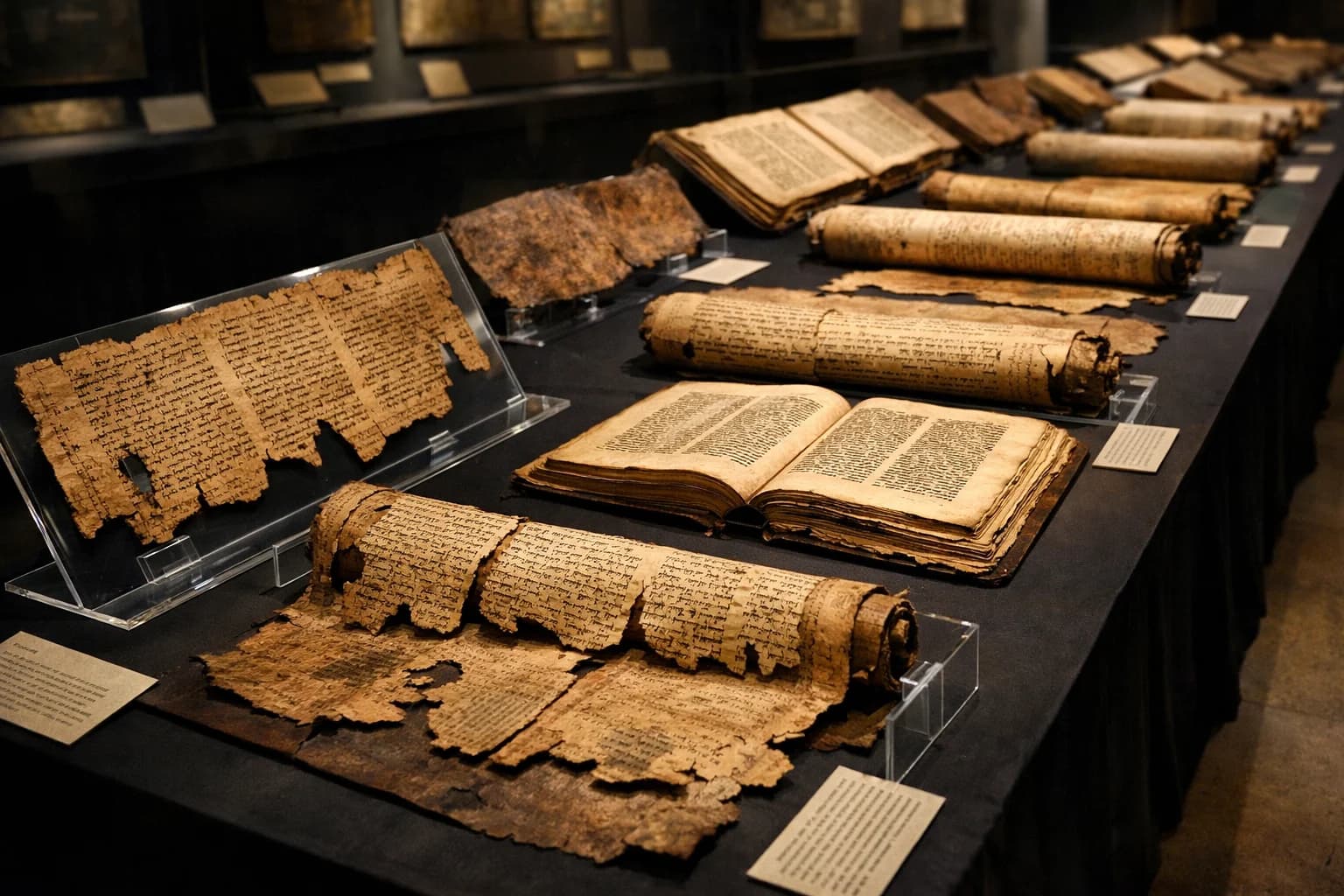
Trace the Bible's Journey Through Ancient Manuscripts
From the Dead Sea Scrolls to the King James Version. Explore the physical artifacts and transmission history behind every book of the Bible, including the major codices, papyri, and translation traditions that carried scripture across centuries and languages.
What is Manuscript History?
The Bible did not arrive as a single bound volume. Its books were written over more than a thousand years, copied by hand on papyrus and parchment, translated from Hebrew, Aramaic, and Greek into Latin, Syriac, Coptic, and eventually into every major language on earth. The Manuscript History tool traces this remarkable journey, showing the physical artifacts and transmission chain behind the scripture we read today.
The earliest surviving manuscripts of the Hebrew Bible include fragments from the Dead Sea Scrolls, discovered in caves near Qumran between 1947 and 1956, dating as far back as the third century BC. For the New Testament, the oldest surviving fragments are Greek papyri from the second century AD, including P52 (a fragment of the Gospel of John) and the Chester Beatty Papyri. The great uncial codices -- Codex Sinaiticus, Codex Vaticanus, and Codex Alexandrinus -- date from the fourth and fifth centuries and contain nearly complete copies of both Testaments.
Between the original autographs and the modern printed Bible lies a complex history of copying, translation, and editorial decisions. The Septuagint translated the Hebrew scriptures into Greek centuries before Christ. Jerome's Vulgate became the standard Latin Bible for over a millennium. The work of scholars like Erasmus, Tyndale, and the committees behind the King James Version and modern critical editions built on centuries of manuscript comparison and textual analysis.
Gospel Daily's Manuscript History tool organizes this information in an accessible timeline and reference format. You can explore individual manuscripts, see which books of the Bible they contain, learn about their date, language, and current location, and understand how they relate to the major text families and translation traditions. Whether you are a student of textual criticism or simply curious about how the Bible reached its current form, this tool makes the manuscript tradition approachable and navigable.
How It Works
Explore the manuscript timeline
Browse a chronological timeline of major Bible manuscripts from the earliest fragments through the great codices to the first printed editions, spanning over two thousand years of textual history.
View manuscript details
Select any manuscript to see its date, language, contents (which books it includes), current location, significance to textual scholarship, and how it relates to other manuscripts in its text family.
Trace translation traditions
Follow the paths from Hebrew and Greek originals through the Septuagint, Vulgate, Syriac Peshitta, and into English translations like the King James Version, tracing how each tradition drew on specific manuscript sources.
Key Features
Manuscript Catalog
A comprehensive catalog of the most important Bible manuscripts, from Dead Sea Scroll fragments to the great uncial codices, with dates, contents, and scholarly significance for each.
Chronological Timeline
A visual timeline spanning from the earliest surviving fragments (third century BC) through medieval manuscripts to the first printed Bibles, showing the arc of textual transmission.
Translation Lineage
Trace the path from the original Hebrew, Aramaic, and Greek texts through the Septuagint, Vulgate, and English translation traditions, showing which manuscripts informed which translations.
Manuscript Locations
Learn where the major manuscripts are housed today -- from the British Library and Vatican Library to university collections around the world -- with context about their discovery and preservation.
A real manuscript entry from the database — Codex Sinaiticus:
Codex Sinaiticus (Aleph)
One of the two oldest complete manuscripts of the Greek New Testament. Contains the earliest complete copy of the New Testament along with much of the Old Testament in the Septuagint tradition.
Details
Mid-4th century AD (~330-360). Written on parchment in uncial (capital) letters with no spaces between words. Currently held across British Library (London), Leipzig, St. Petersburg, and Mt. Sinai.
Contents & Significance
Complete New Testament; portions of the Old Testament in Septuagint. Discovered at St. Catherine's Monastery by Constantin von Tischendorf. One of the earliest witnesses to the Gospels and Pauline epistles. Contains additional books: Epistle of Barnabas and Shepherd of Hermas.
Frequently Asked Questions
What are the Dead Sea Scrolls?
The Dead Sea Scrolls are a collection of nearly 1,000 manuscripts discovered in caves near Qumran on the northwestern shore of the Dead Sea between 1947 and 1956. They include the oldest known copies of many Old Testament books, dating from the third century BC to the first century AD. The scrolls confirmed the remarkable accuracy of the Masoretic text tradition while also revealing textual variations that inform modern scholarship.
What is Codex Sinaiticus?
Codex Sinaiticus is a fourth-century Greek manuscript containing the oldest complete copy of the New Testament and much of the Old Testament in the Septuagint translation. It was discovered at Saint Catherine's Monastery in the Sinai Peninsula in the 1840s and 1850s. Most of the manuscript is now held by the British Library. It is one of the most important witnesses to the text of the New Testament.
How many manuscripts of the New Testament exist?
Scholars have cataloged over 5,800 Greek manuscripts of the New Testament, ranging from small fragments containing a few verses to complete copies of the entire text. In addition, there are over 10,000 Latin manuscripts and thousands more in Syriac, Coptic, Armenian, and other ancient languages. This wealth of manuscript evidence is unparalleled among ancient texts and allows scholars to reconstruct the original text with a high degree of confidence.
What is textual criticism?
Textual criticism is the scholarly discipline of comparing manuscript copies to reconstruct the most likely original text of a document. Because the original autographs of the biblical books have not survived, scholars compare the thousands of surviving copies -- noting agreements and differences -- to determine what the authors most likely wrote. The Manuscript History tool presents the key manuscripts that textual critics rely on for this work.
How did the King James Version relate to ancient manuscripts?
The King James Version (1611) was translated primarily from the Textus Receptus, a Greek New Testament text compiled by Erasmus and later editors, and from the Masoretic Hebrew text for the Old Testament. The Textus Receptus was based on a relatively small number of late medieval manuscripts. Modern translations like the ESV, NIV, and NASB draw on a broader range of earlier manuscripts, including Codex Sinaiticus and Codex Vaticanus, which were not available to the KJV translators.
Start Using Manuscript History
Full access to Manuscript History and 57+ other study tools.
Starting at $7/mo or $59/yr
Already have an account? Sign in