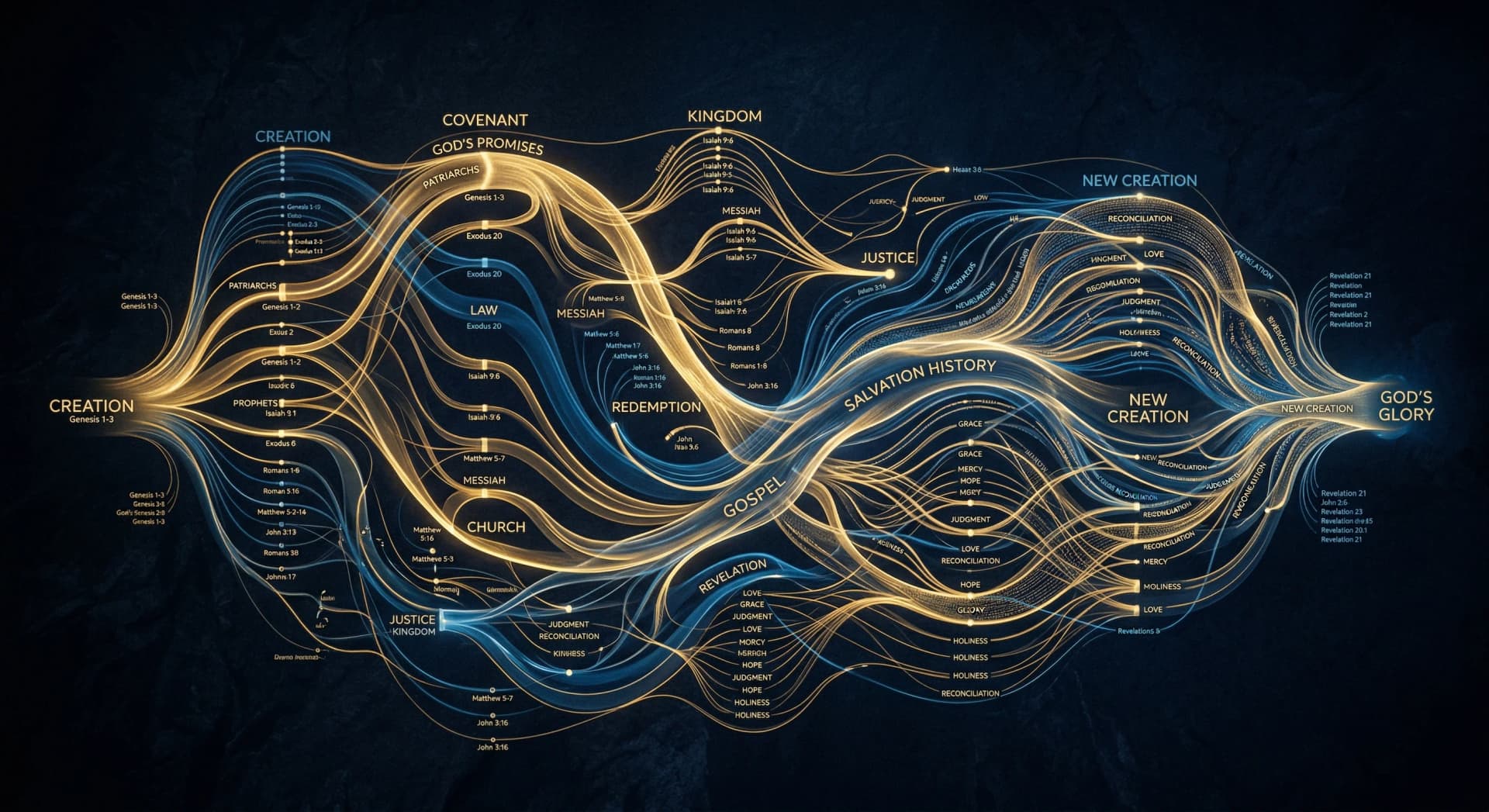
Scripture Flow and Connection Visualization
Watch how Scripture connects and flows. Interactive Sankey diagrams show how volumes reference each other, how the twelve tribes flow through biblical history, and how prophetic themes distribute across books. See the Bible's inner architecture through visual data flow.
What are Scripture Flow Charts?
A Sankey diagram is a visual representation that shows flows between different entities using bands whose width is proportional to the quantity flowing between them. In Scripture Flow Charts, Sankey diagrams reveal relationships and connections across the Bible that would be difficult to see in text form. The width of each band represents the magnitude of the connection -- a thick band between two volumes means many cross-references between them; a thin band means fewer connections. This visual language makes complex data instantly comprehensible.
The Scripture Flow Charts tool presents three different visualizations, each revealing a different kind of biblical connection. The Cross-References flow shows how individual books reference each other, displaying the internal architecture of Scripture's interconnection. The Tribes of Israel flow visualizes the twelve tribes from their origin through Jacob, their tribal territories, the split kingdoms, Babylonian exile, and diaspora -- showing how God's people moved through history. The Prophetic Themes flow shows how major doctrinal themes (redemption, covenant, kingdom, judgment) distribute their frequency across the books of Scripture.
Each flow chart is fully interactive. Hover over nodes (the colored rectangles representing volumes, tribes, or themes) and bands (the connecting flows) to see exact counts. Click on underlined nodes to navigate directly to the relevant scripture passages. The chart reads left to right, with sources on the left flowing to destinations on the right. The proportional width of bands makes it instantly obvious where the densest connections are -- you can see at a glance which biblical volumes are most densely cross-referenced or how tribal history concentrates in certain periods.
For Bible students and teachers, flow charts transform how you understand biblical structure. Rather than seeing the Bible as 66 separate books, flow charts reveal it as a unified system with dense internal connections. Rather than viewing biblical history as a sequence of separate events, they show how themes and peoples flow through time. Rather than knowing doctrines in isolation, they show how themes are distributed and emphasized across Scripture. This visual thinking complements traditional linear study and helps both specialists and beginners see patterns that text-based study easily misses.
How It Works
Choose a flow chart type
Select from three different visualizations: Cross-References (how volumes reference each other), Tribes of Israel (tribal history through biblical periods), or Prophetic Themes (how major doctrines distribute across books). Each tab loads a different Sankey diagram.
Observe the flow patterns
Watch how the colored bands flow from sources (left) to destinations (right). Thicker bands represent greater quantities -- more cross-references, more people, or more verses on a theme. The width instantly shows you where the major connections lie.
Interact with nodes and bands
Hover over any band or node to see exact values. Click underlined nodes to open the relevant scripture passage. Scroll horizontally to see the entire chart. Use the legend to understand what each color represents.
Key Features
Cross-Reference Flows
Visualize how biblical volumes reference each other. See which books have the densest internal connections and how Scripture's 66 books form an interconnected whole through cross-references.
Tribal History Flows
Follow the twelve tribes of Israel from Jacob through tribal territories, kingdom division, Babylonian exile, and diaspora. Watch how God's people flow through biblical history across different periods and regions.
Prophetic Theme Distribution
See how major doctrinal themes like redemption, covenant, kingdom, and judgment flow across the volumes of Scripture. Wider bands show which themes are emphasized most heavily in each book.
Interactive Visualization
Hover to see exact values, click nodes to navigate to scripture, and scroll to view the entire chart. The visual language of flowing bands makes complex biblical connections instantly comprehensible.
A sample cross-reference flow showing how Old Testament and New Testament volumes reference each other:
Cross-Reference Flow
Old Testament (left) flows to New Testament (right). The band width represents the number of cross-references: 850 cross-references from Old Testament to New Testament. Thicker bands reveal which portions of scripture are most densely interconnected. Click any node to navigate to those volumes and explore specific references.
Tribes of Israel Flow
Jacob (Israel) distributes to the twelve tribes: Reuben, Simeon, Levi, Judah, Dan, Naphtali, Gad, Asher, Issachar, Zebulun, Joseph, and Benjamin. These flows then split into the Southern Kingdom (Judah) and Northern Kingdom (Israel), then into the Babylonian Exile (Judah) and Scattered tribes, with flows continuing to Return to Jerusalem and the prophetic Gathering of Israel.
Prophetic Themes
Major doctrinal themes like redemption, covenant, kingdom, and judgment distribute across biblical volumes. Redemption flows heavily through the Gospels and Romans; covenant through Genesis, Exodus, and Hebrews; kingdom through the historical books and the Apocalypse. The width of each theme-to-volume band shows how frequently that theme appears in that book.
Frequently Asked Questions
What is a Sankey diagram and why is it useful for Bible study?
A Sankey diagram uses flowing bands to show connections between entities, with band width representing the quantity of flow. For Bible study, Sankey diagrams reveal patterns invisible in text form. You can instantly see which biblical volumes are most heavily cross-referenced, how tribal lineages flow through history, or how prophetic themes distribute across books. The visual language of flowing proportions makes complex biblical architecture comprehensible at a glance.
What do the different colors in the flow charts represent?
In the Cross-References chart, colors typically represent different scriptural volumes (Old Testament, New Testament, or individual books grouped by category). In the Tribes chart, colors represent individual tribes. In the Prophetic Themes chart, colors represent major doctrinal themes. The legend for each chart explains what each color means, so you always know what you are viewing.
How do I read the cross-reference flow chart?
The cross-reference chart shows biblical volumes on both the left (sources) and right (destinations). The colored bands flowing between them represent cross-references -- when one volume quotes or refers to another. Thicker bands mean more cross-references between those volumes. For example, a thick band from the Psalms to the New Testament shows that New Testament authors frequently quote or reference Psalms. The thickness reveals the density of internal biblical connection.
What does the Tribes of Israel flow chart show?
The Tribes chart visualizes the twelve tribes from their origin through Jacob, their settlement in tribal territories, their division into North and South kingdoms, their experience of the Babylonian exile, and their later scattering and gathering. You can see how tribal history flows through different biblical periods, showing which tribes remain prominent in each era and how redemptive history affects the people of God across centuries.
Can I click on the flow chart to get more information?
Yes. Hover over any band to see the exact quantity (number of cross-references, count of people, or verse count, depending on the chart type). Click on underlined node names to navigate directly to relevant scripture passages. This interactivity lets you explore flows in detail and jump into the text to study what the visualizations show.
Start Using Scripture Flow Charts
Full access to Scripture Flow Charts and 57+ other study tools.
Starting at $7/mo or $59/yr
Already have an account? Sign in