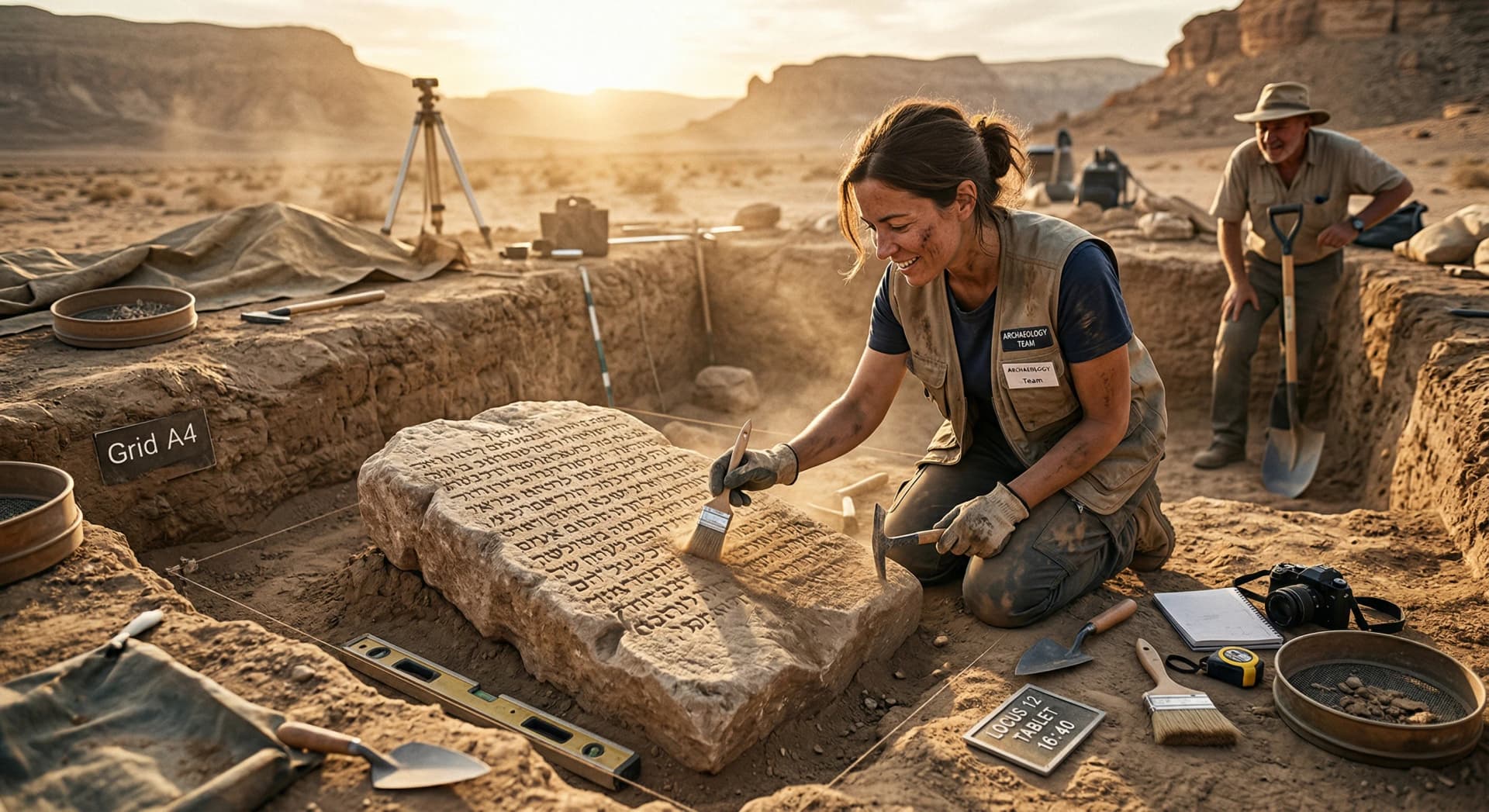
Archaeological Discoveries That Confirm the Bible
Discover how modern archaeology illuminates and validates Scripture. Explore ancient cities, inscriptions, artifacts, and manuscripts that corroborate biblical accounts and show that the Bible is historically grounded in real places and events.
What is Scripture Archaeology?
Scripture Archaeology connects biblical narratives to archaeological discoveries that confirm their historical accuracy. When the Bible names a city, king, battle, or cultural practice, modern excavations often uncover physical evidence—walls, inscriptions, artifacts—proving those accounts are rooted in real history. This tool catalogs major archaeological findings that illuminate biblical passages and validate Scripture's reliability as historical documentation.
The Bible is not merely a spiritual text; it's embedded in ancient Near Eastern history. Archaeological discoveries include fortified cities named in Scripture, inscriptions mentioning biblical kings like Hezekiah and Josiah, seals and bullae bearing names from biblical narratives, pottery and weapons from the periods described, and manuscripts like the Dead Sea Scrolls that preserve biblical texts. Each discovery adds layers of historical context to Scripture and demonstrates that the Bible refers to real geography, real people, and real events.
Discoveries are organized by category (Artifacts, Inscriptions, Cities, Manuscripts, Seals) and by biblical period (Patriarchal, Exodus, Monarchy, Exile, NT Era). For instance, the Tel Dan Stele contains an inscription mentioning 'the house of David,' corroborating the existence of the Davidic dynasty referenced throughout Scripture. The Pilate Stone confirms Pontius Pilate's historical existence and role as prefect of Judea. The Mesha Stele describes a 9th-century battle in Moab mentioned in 2 Kings. These findings transform Bible reading from abstract study into connection with tangible historical reality.
Understanding the archaeological context of Scripture deepens faith by showing that God acted within real history, in real places, with real peoples. The Bible is not mythology or allegory; it's a historical narrative grounded in the ancient world, confirmed by independent archaeological evidence. This tool helps you see Scripture as reliable historical testimony while also recognizing its spiritual significance.
How It Works
Search or filter discoveries
Search by name, location, or detail, or filter by discovery type (Artifacts, Inscriptions, Cities, Manuscripts, Seals) and biblical period (Patriarchal through NT Era).
View discovery details
Each discovery card shows location, discovery date, category, and biblical period. Click to expand and read detailed description and theological significance.
See the biblical connections
Each discovery includes the specific Bible references it illuminates, showing you exactly which Scripture passages are confirmed or given historical context by the archaeological find.
Key Features
Archaeological Discovery Database
Browse hundreds of archaeological findings organized by type and biblical period. Each discovery includes location, date discovered, and the Scripture it illuminates.
Scripture References
Every discovery is linked to the specific Bible passages it confirms, illuminates, or provides historical context for. See exactly which biblical accounts are supported by archaeology.
Searchable by Category & Period
Filter discoveries by type (Artifacts, Inscriptions, Cities, Manuscripts, Seals) and biblical period (Patriarchal through NT Era) to explore specific themes or eras.
Timeline Visualization
A timeline shows how archaeological discoveries cluster across biblical history, revealing patterns of settlement, conflict, and cultural practice.
A real archaeological discovery this tool catalogs:
Tel Dan Inscription
Aramaic inscription on a stone fragment mentioning 'House of David.' Dating to 9th-8th century BCE, it is the only known extra-biblical reference to the Davidic dynasty.
Discovery Details
Location: Tel Dan, Israel • Date Discovered: 1993 • Period: Monarchy
Biblical Connection
2 Samuel 7:12-14; 1 Kings 11:36; 1 Samuel 16:13
Archaeological Significance
First archaeological confirmation outside the Bible of the historical David and his dynasty, validating biblical accounts of David's historical existence and kingdom establishment.
Frequently Asked Questions
What is biblical archaeology?
Biblical archaeology is the study of ancient Near Eastern sites and artifacts that illuminate or corroborate passages in the Bible. It bridges biblical studies and historical archaeology, using excavation, inscription analysis, and artifact study to confirm that the Bible's historical accounts align with archaeological evidence from the ancient world.
Does archaeology prove the Bible is true?
Archaeology cannot prove the spiritual truth claims of the Bible (that God exists, that Jesus rose from the dead), but it does confirm the Bible's historical accuracy. Discoveries consistently validate biblical names of cities, kings, and peoples, showing that biblical narratives are grounded in real history rather than fiction or mythology. This historical reliability strengthens confidence in Scripture.
What are some famous biblical archaeology discoveries?
Famous discoveries include the Tel Dan Stele (mentioning 'the house of David'), the Pilate Stone (confirming Pontius Pilate), the Mesha Stele (describing a battle in Moab), the Dead Sea Scrolls (ancient biblical manuscripts), the Pool of Bethesda, and the Galilee Boat (a 1st-century fishing vessel from Jesus's era). Each confirms or illuminates biblical accounts.
Have archaeologists found evidence of Jesus?
While no artifact has been directly attributed to Jesus, archaeology has confirmed many details about first-century Judea and people mentioned in the Gospels. The Pool of Bethesda, sites of synagogues Jesus visited, ossuary inscriptions, and references to Roman officials mentioned in the Gospels all confirm the historical context and plausibility of Gospel accounts.
What is the Dead Sea Scrolls and why do they matter?
The Dead Sea Scrolls are ancient Hebrew manuscripts discovered near the Dead Sea, dating from the 3rd century BC to 1st century AD. They include copies of nearly every book of the Old Testament and prove that biblical texts were meticulously preserved across centuries. The scrolls confirm that the Bible we read today matches texts from over 2,000 years ago, demonstrating biblical reliability.
Start Using Scripture Archaeology
Full access to Scripture Archaeology and 57+ other study tools.
Starting at $7/mo or $59/yr
Already have an account? Sign in