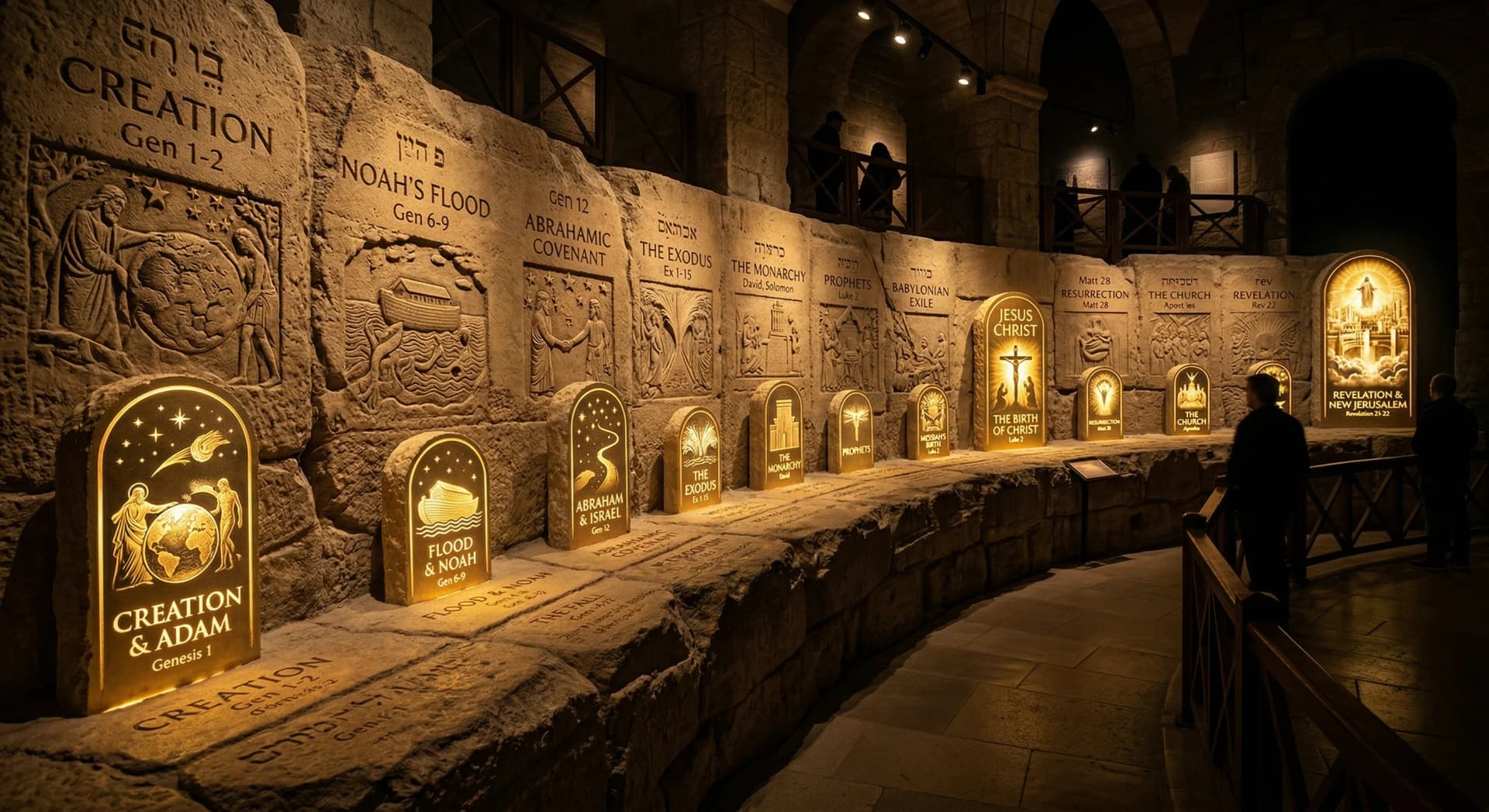
Interactive Scripture Timeline from Creation to the Early Church
Explore a visual chronological timeline of every major event across the Bible. See prophets, historical eras, and scripture events placed in context from the earliest biblical period through the early church.
What is the Scripture Timeline?
The Scripture Timeline is an interactive chronological tool that places every major scriptural event on a single visual timeline spanning from the earliest biblical period through the early church. Events are drawn from the Old and New Testaments and displayed in a unified view that reveals how God's dealings with His people have unfolded across the millennia.
One of the greatest challenges in scripture study is understanding when events occurred relative to one another. Was Isaiah before or after the Babylonian exile? Were Daniel and Jeremiah contemporaries? How many years separated the Old Testament prophets from the apostolic era? The Scripture Timeline answers these questions visually, placing each event at its approximate date with color-coding by testament so you can instantly see which scripture source records the event.
The timeline also displays the lifespans of major prophets, showing when they lived, how long they served, and which prophets overlapped in time. This prophet layer transforms isolated biographical details into a connected narrative -- you can see that Elijah and Elisha served in succession, that Daniel lived through the entire Babylonian captivity, and that the prophets witnessed the judgments of God upon Israel.
For Christians, the era view is particularly valuable. The timeline divides history into the major eras recognized in scripture, from the patriarchs through the early church. This view helps you see how God has worked through different periods of history, and it places each era in its proper chronological and theological context.
How It Works
Browse the timeline
Scroll through the chronological timeline from the earliest biblical events to the early church. Events are color-coded by scripture volume for instant recognition.
Filter by volume or era
Narrow the view to a specific scripture volume, a single era, or a date range. Toggle prophet lifespans on or off to focus on the layer that interests you.
Read event details
Click any event to see its description, scripture reference, and direct link to the relevant chapter so you can read the full text in context.
Key Features
Unified Chronology
Events from the Bible placed on a single timeline, revealing connections between Old Testament, New Testament, and Christian history.
Prophet Lifespans
Visual bars showing when each prophet lived and served, making it easy to see who was contemporary with whom and how prophetic ministry overlapped.
Era Bands
Historical periods divided into the major eras from the patriarchs to the apostolic age, showing the pattern of God's covenant relationship with His people.
Scripture-Linked Events
Every event on the timeline links to its source chapter and verse, so you can move from the visual overview directly into the scriptural text.
The Scripture Timeline visualizes how major events span from Creation through the apostolic era. Here's a sample of key biblical events:
The Flood and Tower of Babel
Year -2344: The Great Flood — Noah builds an ark at God's command, and the earth is cleansed by a great deluge (Genesis 7:11). Two centuries later comes the Tower of Babel (Year -2200): The people attempt to build a tower to heaven; God confounds their language and scatters them (Genesis 11:4).
Moses and Mount Sinai
Year -1500: Moses and the Burning Bush — God appears to Moses in a burning bush on Mount Horeb and calls him to deliver Israel from Egypt (Exodus 3:2). Fifteen years later, Year -1490: Ten Commandments Given — God delivers the Ten Commandments to Moses on Mount Sinai as the foundation of His law for Israel (Exodus 20:1).
David's Dynasty
Year -1000: David Slays Goliath — The young shepherd David defeats the Philistine giant Goliath with a sling and a stone in the name of the Lord (1 Samuel 17:49). Ten years later, Year -990: David Becomes King of Israel — David is anointed king over all Israel and establishes Jerusalem as the capital city (2 Samuel 5:3).
Jesus Christ — The Fullness of Time
Year 1: Birth of Jesus Christ — Jesus Christ is born in Bethlehem, the Son of God, the long-awaited Messiah of all mankind (Luke 2:7). Year 33: The Crucifixion — Jesus Christ is crucified at Golgotha, giving His life as the once-for-all sacrifice for sin (Luke 23:33). Three days later, Year 33: The Resurrection — Jesus Christ rises from the tomb, conquering death and opening the way for all to live again (Matthew 28:6).
Frequently Asked Questions
What is a Bible timeline?
A Bible timeline is a chronological chart that places biblical events in their approximate historical order and date. It helps readers understand when events occurred relative to one another and to secular history. The Scripture Timeline creates a unified biblical chronology spanning both testaments.
How accurate are the dates on the Scripture Timeline?
Dates for well-documented periods such as the Babylonian exile (586 BC), the reign of Herod the Great, and the life of Paul are based on established historical and archaeological evidence. Earlier dates, such as those for the patriarchs and the Exodus, follow traditional biblical chronology. Where scholarly debate exists, the timeline uses the most widely accepted estimates and notes any uncertainty.
What are the major eras of biblical history?
The timeline groups Scripture into eras that historians and biblical scholars commonly use: the Primeval Age, the Patriarchs, the Exodus and the Law, the Kingdom, the Exile and Return, the Second Temple period, Christ and the Apostles, and the Church Age. Each era builds on the one before it, culminating in the new covenant established by Christ.
Were Daniel and Jeremiah alive at the same time?
Yes. Both Daniel and Jeremiah were active in the period leading up to and during the Babylonian exile (around 600 BC). The Scripture Timeline shows this overlap clearly, placing both prophets in the same era, just before and during the Babylonian destruction of Jerusalem in 586 BC.
Does the Scripture Timeline cover both testaments?
Yes. The Scripture Timeline includes events from the Old and New Testaments displayed along a unified timeline at their approximate dates. Each event is color-coded by testament for visual clarity.
Start Using Scripture Timeline
Full access to Scripture Timeline and 57+ other study tools.
Starting at $7/mo or $59/yr
Already have an account? Sign in