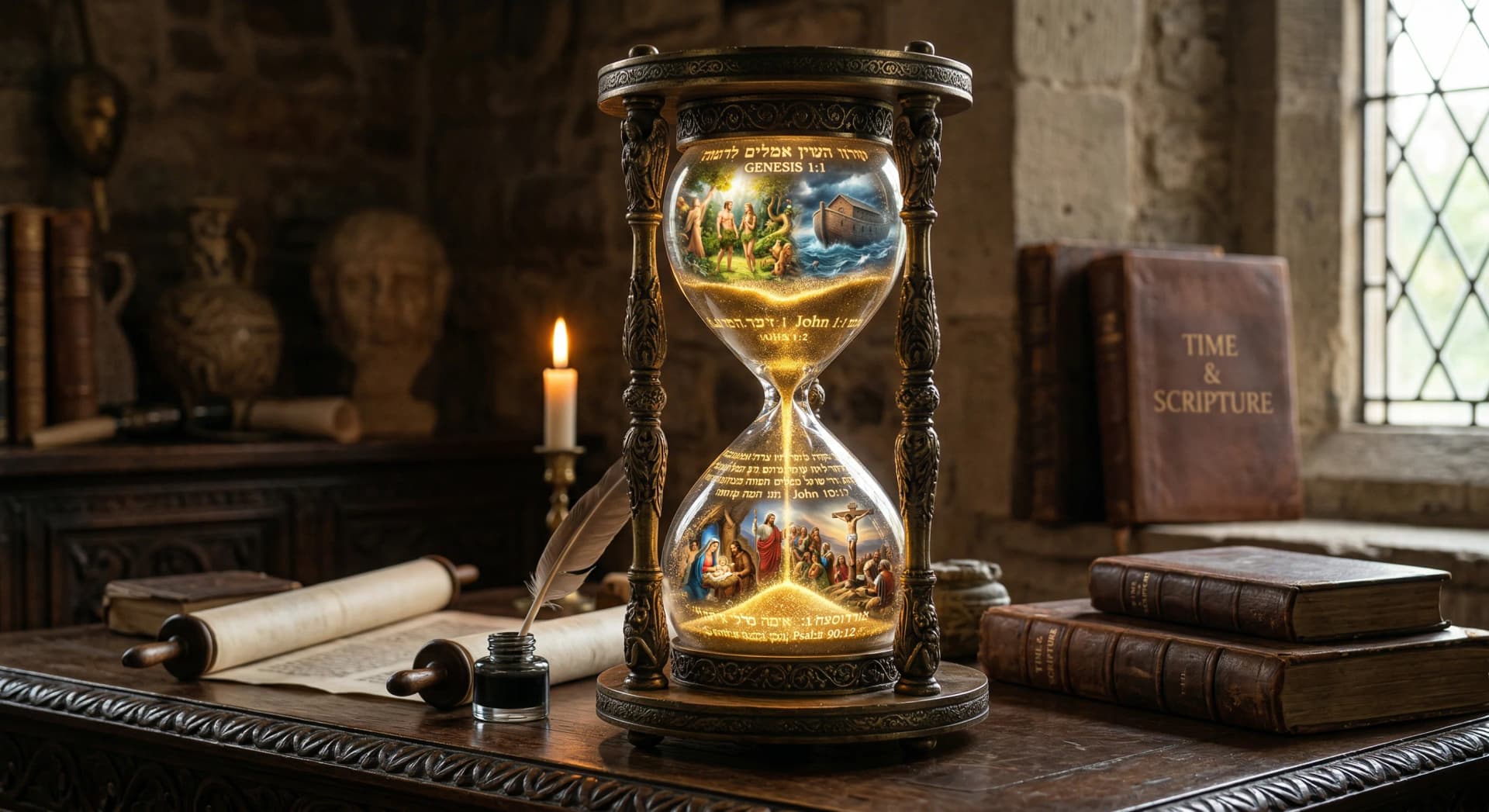
Scripture Through the Eyes of History
The words have not changed -- the readers have. See how the same verse was understood by an ancient Israelite, a medieval monk, a Reformation scholar, a pioneer Saint, and a modern reader, revealing layers of meaning that deepen with each era.
What Is the Time Travel Reader?
The Time Travel Reader takes a single verse of scripture and shows you how it would have been understood by readers from different centuries and cultures. The text of the verse remains the same, but the context surrounding each reader -- their language, their theology, their historical circumstances -- changes everything about what the words mean. By stepping into the shoes of an ancient Israelite hearing the words of Moses, a first-century Christian reading Paul's letters, a medieval scholar poring over a Latin manuscript, or a Christian pioneer reading by candlelight, you gain a richer understanding of the passage than any single perspective can offer.
This approach to scripture study recognizes something that careful readers have always known: a verse does not exist in a vacuum. The meaning of 'covenant' to an Israelite standing at Sinai is different from its meaning to a Christian in the Roman Empire, and different again from its meaning to an Orthodox Christian in Constantinople or a Reformation theologian in Geneva. None of these readings is wrong -- they are all part of the story of how God's word has been received across time. The Time Travel Reader makes these different reception histories visible and accessible.
Each verse in the Time Travel Reader is annotated with multiple historical eras. For each era, you see who the reader is, what year they are reading in, and how they would have understood the passage given their context. At the end, a 'Gap' section highlights what has changed most dramatically between the earliest and most recent readings -- the distance the verse has traveled across time and what has been gained or lost along the way.
For Christians, the Time Travel Reader is especially illuminating because it reveals how interpretation has shifted across the centuries. Seeing how a verse was understood in the apostolic era, through the medieval period, and into the modern age brings the history of biblical interpretation to life. You can literally trace the journey of a doctrine from its original context through centuries of reinterpretation and into its modern understanding.
How It Works
Choose a verse
Browse the collection of annotated verses or search by reference or keyword to find a passage that interests you.
Travel through time
Read how the same verse was understood by readers from different historical eras, each with their own cultural and theological context.
See the gap
Review the 'Gap' summary that highlights what has changed most dramatically in how the verse has been read across the centuries.
Key Features
Multi-Era Annotations
Each verse includes detailed annotations from multiple historical periods, showing how the same text was received by readers separated by centuries.
Historical Reader Profiles
Every era includes a description of who the reader is and what their world looked like, grounding the interpretation in real historical context.
The Gap Analysis
A synthesis section highlights the most significant shifts in understanding between the earliest and most recent readings of each verse.
Searchable Verse Collection
Search by verse reference or keyword to find annotated passages, or browse the full collection to discover verses with the most dramatic historical journeys.
How the same verse was understood by readers separated by centuries:
Ancient Hebrew (1400 BC)
Understood within ancient Near Eastern cosmology: God (Elohim) as supreme over all creation, contrasting sharply with neighboring myths where the world emerges from divine conflict. The Hebrew listener heard a polemic against Babylonian and Canaanite creation myths -- no battle among gods, no primordial chaos. Creation is an act of sovereign will.
Medieval Benedictine (1100 AD)
Read within the framework of the Hexaemeron tradition -- elaborate commentaries on the six days of creation. The verse was understood as establishing God's absolute sovereignty and the goodness of material creation against Cathar heresies that viewed the physical world as evil. The 'beginning' was linked to Christ through John 1:1 in lectionary readings.
Martin Luther (1520 AD)
Emphasized the plain, literal sense: God created everything from nothing by His Word alone. Luther rejected allegorical readings and used this verse to teach that the material world is fundamentally good because God made it. Creation reveals God's power but not His saving grace -- for that, one needs the Gospel.
Modern Scholar (2020)
Modern scholarship engages with the Hebrew grammar: 'bereshit' may mean 'In the beginning' (absolute) or 'When God began to create' (construct state). The relationship between Genesis 1 and modern science is vigorously debated among young-earth creationists, old-earth creationists, and those who read Genesis as theological narrative rather than scientific description.
Frequently Asked Questions
What does the Time Travel Reader show?
The Time Travel Reader takes a single verse of scripture and shows how it would have been understood by readers from different historical eras. Each era includes a description of the reader, the approximate year, and an explanation of how they would have interpreted the verse given their cultural and theological context. A 'Gap' section summarizes the most significant differences between the readings.
How does historical context change the meaning of a scripture verse?
The same words can carry very different meanings depending on the reader's language, culture, theology, and life experience. For example, the word 'baptism' meant something different to a Jewish audience familiar with ritual immersion than it did to a Greek reader encountering the concept for the first time. The Time Travel Reader makes these contextual differences visible so you can appreciate the full range of meaning a verse has carried across history.
Why is this useful for Christians?
Christianity has a rich history of interpreting scripture across centuries and cultures. The Time Travel Reader lets you see this process in action -- tracing how a verse was understood in its original context, how its meaning shifted during different eras, and how later scholarship recovered or expanded its original significance.
Which verses are available in the Time Travel Reader?
The Time Travel Reader includes a curated and growing collection of verses from across the Bible that have particularly rich histories of interpretation. These are verses where the shift in understanding across eras is especially dramatic or theologically significant. You can search by reference or browse the full collection.
Can I use this tool for teaching about church history?
Yes. The Time Travel Reader is an excellent teaching resource for lessons about the history of biblical interpretation. By showing how specific doctrines were understood differently across the centuries, it provides concrete, verse-level examples that go far beyond abstract discussion.
Start Using Time Travel Reader
Full access to Time Travel Reader and 57+ other study tools.
Starting at $7/mo or $59/yr
Already have an account? Sign in