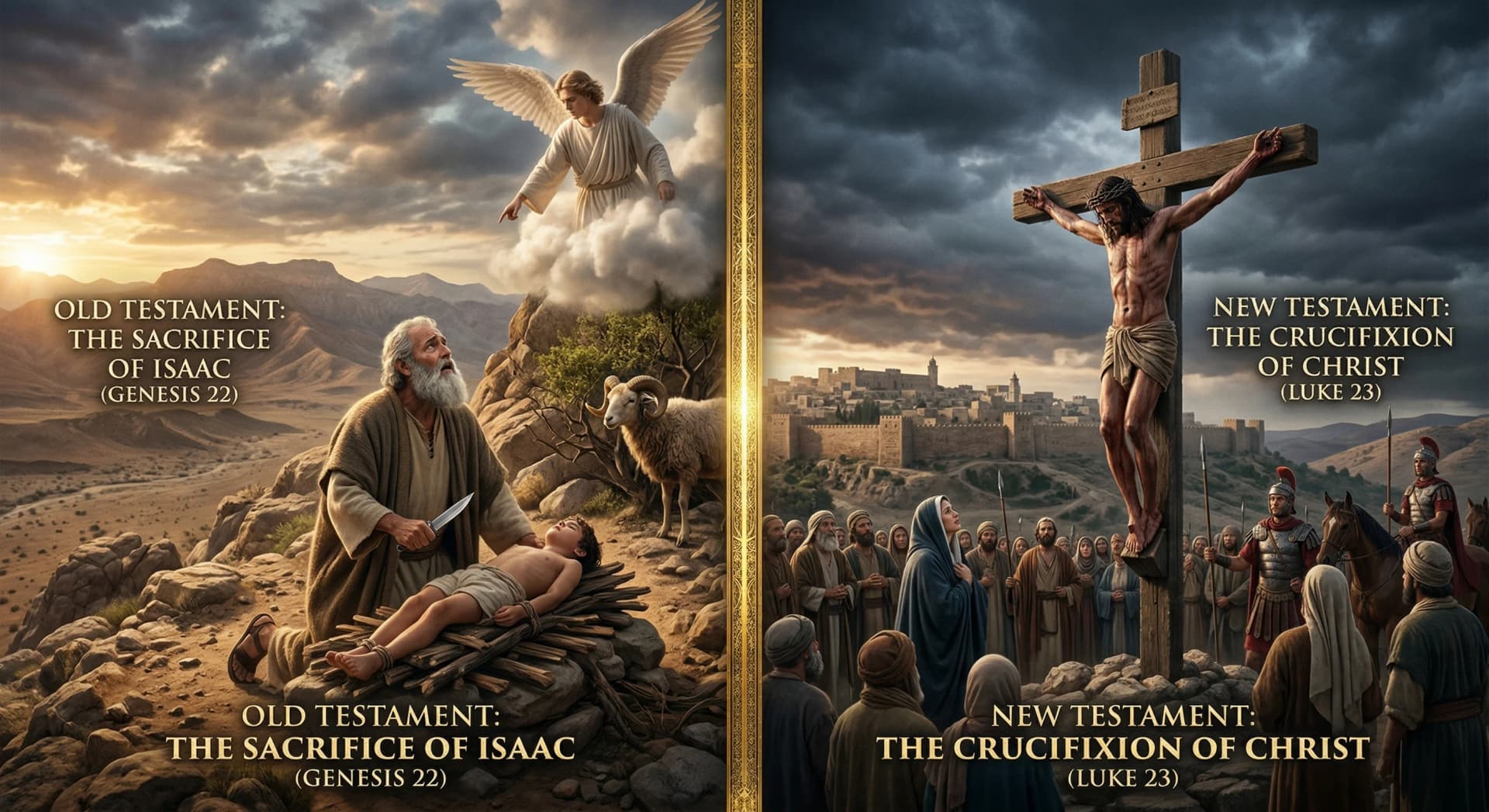
Explore Biblical Typology: From Shadow to Substance
See how Old Testament types reveal and anticipate New Testament realities. Understand the hidden unity between Old and New Testaments through typological connections.
What Is Biblical Typology?
Biblical typology is a method of biblical interpretation that views Old Testament persons, events, objects, and institutions as prefiguring or foreshadowing their fulfillment in the New Testament, particularly in Christ and His work of redemption. A 'type' is the Old Testament prefiguration; the 'antitype' is the New Testament fulfillment.
Typology is grounded in the New Testament itself. The Apostle Paul writes that Adam is a type of Christ (Romans 5:14). Jesus Himself applies the Jonah typology to His resurrection (Matthew 12:40). The writer of Hebrews systematically develops the typology of the Old Testament priesthood, sacrifices, and the Tabernacle as pointing to Christ's person and work.
Typology differs from allegory in that it is grounded in historical reality and often has explicit New Testament attestation. The types were real people, real events, and real objects. Their typological significance does not diminish their historical reality or their original meaning to their contemporaries. Rather, God ordained these realities to serve a dual purpose: they had immediate meaning in their time and prophetic meaning pointing forward to Christ.
The Typology Explorer tool organizes over 60 typologies across five categories: People (15+), Events (15+), Objects (15+), Institutions (8+), and Places (7+). For each typology, you'll find the Old Testament type with its reference, the New Testament antitype with its reference, the theological connection between them, and any explicit New Testament verse that makes the connection.
How It Works
Browse by category
Explore typologies organized by category: People, Events, Objects, Institutions, or Places. Or search by type, antitype, or title to find specific typologies.
View the type and antitype side-by-side
See the Old Testament type on the left (with its reference and description) and the New Testament antitype on the right (with its reference and description).
Expand for deeper insights
Expand any card to see the theological connection between type and antitype, the New Testament authority verse (if applicable), and the significance of the typology.
Key Features
60+ Documented Typologies
Comprehensive coverage including person typologies (Adam, Isaac, Joseph, Moses, David, etc.), event typologies (Exodus, Passover, Red Sea crossing, etc.), object typologies (Ark, Tabernacle, Bronze altar, etc.), institution typologies (Sabbath, priesthood, sacrifices, festivals), and place typologies (Eden, Egypt, Promised Land, etc.).
Side-by-Side Type and Antitype
View the Old Testament type and New Testament antitype in parallel, with biblical references, descriptions, and visual distinction between shadow and substance.
Organized by Category
Browse typologies organized into five categories (People, Events, Objects, Institutions, Places) to explore typological patterns by theme or type.
Theological Insight
For each typology, discover the theological connection explaining how the type foreshadows the antitype, plus any explicit New Testament verse making the connection.
A type and its fulfillment:
Adam (Type)
Genesis 2:7; 3:15 — Adam is the first man created in God's image, who brought sin and death to all mankind through his disobedience.
Christ (Antitype)
Romans 5:14 — Just as Adam's sin brought condemnation to all, Christ's righteousness brings justification to all who believe. Adam was created; Christ is the Creator.
Frequently Asked Questions
What is biblical typology?
Biblical typology is a method of interpretation where Old Testament persons, events, objects, or institutions (types) prefigure or foreshadow their New Testament fulfillment (antitypes), particularly in Christ. For example, the Passover lamb is a type of Christ, who is the Antitype—the ultimate Lamb of God.
What's the difference between typology and allegory?
Typology interprets real historical persons, events, and objects as having a secondary prophetic meaning. Allegory treats a narrative as though it were entirely symbolic with little concern for historical reality. Typologies are often explicitly affirmed in the New Testament, while allegorical interpretations are more subjective.
Are there New Testament examples of typology?
Yes. Jesus Himself applies the Jonah typology to His resurrection (Matthew 12:40). Paul identifies Adam as a type of Christ (Romans 5:14). The entire book of Hebrews systematically develops the typology of the Old Testament priesthood, sacrifices, and Tabernacle as pointing to Christ.
How many typologies does this tool cover?
The Typology Explorer includes 60+ typologies organized across five categories: People (15+), Events (15+), Objects (15+), Institutions (8+), and Places (7+). Each typology includes biblical references, descriptions, and theological significance.
Can I use this tool for teaching?
Absolutely. The Typology Explorer is an excellent resource for teaching about biblical typology because it systematically presents types and antitypes side-by-side with explicit theological connections and New Testament authority verses. It's ideal for Bible studies, Sunday school lessons, and sermons on christological typology.
Does typology diminish the literal meaning of Old Testament passages?
No. Typology does not replace or diminish the literal, historical meaning of Old Testament passages. The types were real events with real meaning for their contemporaries. God simply ordained them to have a secondary prophetic significance pointing forward to Christ—an additional layer of meaning, not a replacement.
Start Using Typology Explorer
Full access to Typology Explorer and 40+ other study tools.
Starting at $7/mo or $59/yr
Already have an account? Sign in