What Does Selah Mean in the Bible? The Psalms Mystery Explained
What Does Selah Mean in the Bible? The Psalms Mystery Explained
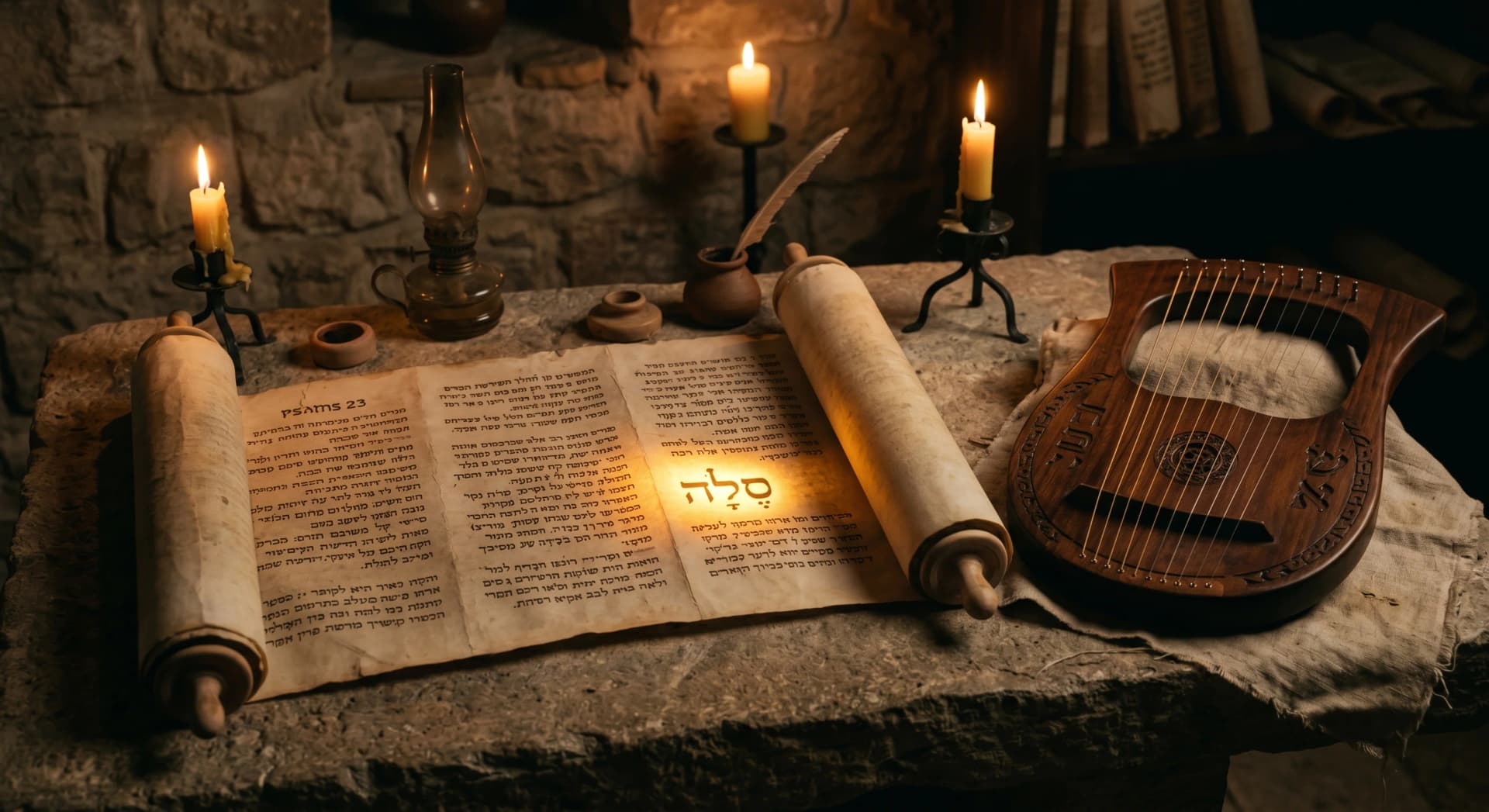
Selah (סֶלָה) definition: A Hebrew word appearing 77 times in Scripture (74 in Psalms, 3 in Habakkuk) whose exact meaning remains debated by scholars. The most likely definitions are: (1) a musical pause or rest, (2) a direction to lift up or amplify, (3) an affirmation like "amen," or (4) a marker for meditation. Despite centuries of study, selah remains one of the Bible's most fascinating word mysteries.
If you've read the Psalms carefully, you've noticed a word that appears throughout: selah. It shows up suddenly, seemingly at random, breaking up verses and stanzas. You'll see it in your Bible—sometimes italicized, sometimes in brackets, sometimes as a footnote. But what does it mean? Why is it there? And what should it mean for us as modern readers?
The truth is: even scholars don't fully agree. But the mystery itself is worth exploring, because selah opens a window into how ancient Israel worshipped, and how we might worship more meaningfully today.
Where Selah Appears in the Bible
Selah is distinctly a biblical word—it appears nowhere else in ancient literature or the modern world. Its distribution is specific and intentional:
In the Psalms: 74 occurrences across 39 different Psalms. Psalm 3 contains four instances. Psalm 46, 47, and 48 each have three. Others have just one or two. The placement is rarely random—most often at the end of a stanza or at a turning point in the song.
In Habakkuk: 3 occurrences, all in Chapter 3, which is structured as a prayer or psalm embedded in the prophecy. This consistency suggests Habakkuk 3 was meant to be sung or chanted in worship.
Never in the New Testament: This is significant. Selah is entirely an Old Testament phenomenon, suggesting it belonged to Israel's liturgical practice rather than a concept Christians needed to carry forward.
This distribution pattern itself is a clue: selah wasn't randomly scattered. It appears at purposeful moments—often at transitions between ideas, at the peak of emotion, or at the end of a thought.
The Four Main Scholarly Theories About Selah
For over 2,000 years, Bible scholars have proposed different meanings for selah. None has achieved universal agreement, but these four theories are most credible:
Theory 1: Musical Pause or Rest
The evidence: The word likely derives from the Hebrew verb salah (שׁלה), meaning "to pause," "to rest," or "to hang." This is the most popular modern scholarly position. If this is correct, selah is a direction to the musicians or singers to take a break—to pause before continuing.
What it meant in worship: Musicians would stop playing. Singers would be silent. The congregation would listen to silence, breathe, and perhaps reflect. In a worship setting, this pause would create space—emotional and spiritual space—for the weight of what was just sung to sink in.
Why this makes sense: Many Psalms deal with intense emotional or spiritual content. Psalm 3, for example, is David crying out to God while enemies surround him. A pause after "But you, LORD, are a shield around me" (Psalm 3:3) allows that truth to land deeply. Silence can be more powerful than words.
Theory 2: Lift Up or Amplify
The evidence: Some scholars propose selah derives from salal, meaning "to lift up" or "to exalt." In this interpretation, selah would be a direction to lift up the voice, increase volume, or elevate the music—a crescendo or climactic moment.
What it meant in worship: Selah could have signaled musicians to lift their instruments higher, to play louder, or to build toward a peak. It might have indicated the congregation should lift their voices in response or acclaim.
Why this makes sense: Many Psalms build toward declarations of God's greatness or power. "He is my shield and the horn of my salvation, my stronghold" (Psalm 27:3) followed by selah could mean: "Now sing this louder! Declare it with greater conviction!"
Theory 3: Amen or Affirmation
The evidence: Some propose selah comes from salal, meaning "to praise" or "to lift up in praise," making it functionally similar to "amen"—an affirmation or agreement. The Septuagint sometimes translated selah concepts with terms meaning "confirmation" or "truth."
What it meant in worship: Selah would function like "amen"—a marker where the congregation affirms what was sung. A cantor would sing a line, then the congregation would respond with "selah"—essentially saying "Yes, this is true. We affirm this."
Why this makes sense: This interpretation positions selah as a liturgical response, transforming worship from monologue to dialogue. It explains why selah appears at moments of profound truth—after declarations about God's character, protection, or justice.
Theory 4: Meditation Marker
The evidence: Some scholars, particularly in Jewish interpretive tradition, suggest selah means "forever" or signals a place to meditate and contemplate. The Targum (Aramaic paraphrase) sometimes rendered selah as "forever," and the Talmud discusses selah as a moment for meditation.
What it meant in worship: Selah became a moment to stop singing and thinking, to sit with the spiritual reality just expressed. If a Psalm declares "The LORD is my shepherd," selah is the breath before the soul internalizes that truth.
Why this makes sense: The Psalms are intensely spiritual texts. They move through lament, petition, remembrance, and resolution. A pause for meditation between sections allows singers and readers to process the journey emotionally and spiritually, not just cognitively.
Why Selah Was Lost in Translation
Here's an interesting historical fact: modern Bible translations rarely even footnote selah properly. Some omit it entirely. Others italicize it or put it in brackets. Why?
The Septuagint translation: When the Hebrew Bible was translated into Greek (the Septuagint, around 250 BCE), translators rendered selah as diapsalma (διάψαλμα), literally "musical interlude." This Greek word appeared in ancient musical notation and contexts. This choice suggests the Greek translators understood selah as a musical direction, not a conceptual word.
Jerome and the Latin Vulgate: When Jerome translated the Bible into Latin (around 400 CE), he largely preserved the term selah, making it transliteration rather than translation. This created a two-track system: some languages kept the Hebrew word (transliterated), others translated it or ignored it.
Modern translation choices: Contemporary English translations struggle with selah because:
- Its exact meaning is uncertain
- It's not a word modern readers understand
- It doesn't fit English grammar naturally
- Some argue it's purely liturgical and not essential to meaning
The King James Version kept selah as-is. The NIV and ESV mark it in brackets or notes. Some study Bibles explain it in footnotes. But most readers encounter selah without understanding it—a word floating in the text with no anchor.
Selah in Context: Notable Examples
Let's look at three passages where selah appears and see how it illuminates the text.
Psalm 3:2-4: David's Crisis and Confidence
Many say of me, "God will not deliver him." But you, LORD, are a shield around me, my glory, the One who lifts my head high. I call out to the LORD, and he answers me from his holy mountain. Selah.
Here, David is surrounded by enemies who mock him, declaring God won't help. But David affirms that God is his shield. Then—selah.
What happens in that pause? If selah is rest, David's declaration settles. If selah is affirmation, the congregation agrees. If selah is amplification, David's confidence builds. If selah is meditation, the reader absorbs the paradox: enemies mock, but God shields.
Psalm 46:1-3: God's Presence in Chaos
God is our refuge and strength, an ever-present help in trouble. Therefore we will not fear, though the earth give way and the mountains fall into the heart of the sea, though its waters roar and foam and the mountains quake with their surging. Selah.
In this passage, the Psalm describes catastrophe—earth shaking, mountains falling into the sea. It's apocalyptic imagery. Then selah interrupts.
That pause is essential. The reader just absorbed statements about cosmic chaos. The selah says: stop, breathe, let this reality land. Then the Psalm continues with "God's city..." establishing that even in cosmic chaos, God's presence remains constant.
Habakkuk 3:3: A Prophet's Vision
God came from Teman, the Holy One from Mount Paran. His glory covered the heavens and his praise filled the earth. Selah.
Habakkuk is experiencing a theophany—a direct encounter with God. The selah here seems to mark a moment of awe and silence. It's not a place for more words. It's a place to be still in God's presence.
What Selah Means for Modern Bible Readers
If selah's exact meaning is uncertain, what should you do when you encounter it in Scripture?
Treat it as an invitation to pause. Regardless of whether selah meant rest, amplification, affirmation, or meditation originally, it functions the same way today: it tells you to stop. Slow down. Don't rush past this word.
When reading the Psalms aloud: Pause at selah. Let the previous verse hang in the air. Breathe. This transforms your reading from information-gathering to worship.
When praying or meditating: Use selah as a cue. Read the verse, then at selah, sit in silence for a moment. Let the truth of what you just read sink deeper than intellectual understanding.
In corporate worship: Some congregations have revived selah as a liturgical element. They'll sing a verse, then at selah, everyone is silent together. It creates a powerful shared moment of contemplation.
When struggling to pray: Selah can be your prayer. Sometimes we don't have words. At those moments, selah—a pause, a rest, a moment of silence—speaks louder than fluent sentences.
The Deeper Mystery: Why Selah Matters
The fact that selah appears 77 times and we still don't know exactly what it means reveals something important: the Psalms were never meant to be read only with the head. They were meant to be experienced with the body, the soul, and the community.
A Psalm is not a theology lesson. It's a prayer. It's a song. It's an experience. Selah interrupts the flow to remind us of this. It says: you can't rush through this. You can't skim it. You must pause. You must feel. You must sit with what God is saying.
In our fast-paced world, where we read more information in a day than someone in the 16th century read in a lifetime, selah is a radical gift. It's an ancient practice that slows us down. It gives us permission to be quiet. It reminds us that worship includes silence, rest, and contemplation.
Conclusion: Embrace the Mystery
The uncertainty around selah's meaning doesn't diminish its power—it enhances it. Because we're not entirely sure what it means, we're invited to discover what it means for us. For you, selah might be a musical pause. For someone else, it's an affirmation. For another, it's a moment of meditation.
The beauty is that all four interpretations lead to the same place: deeper encounter with God through the Psalms.
Next time you're reading the Psalms and see that word—selah—don't skip it. Pause. Breathe. Listen to the silence. Let the truth you just read sink into your bones. That ancient word, mysterious though it may be, invites you into the same kind of worship that echoed through Israel's temples thousands of years ago.
Selah.
FAQ: More About Selah
Q: Does my Bible's translation of the word matter? A: Minimally. Most study Bibles will note selah in some form. If your translation omits it, you can cross-reference with another translation to see where it appears. What matters more than the translation is your response to it—pause, reflect, and engage.
Q: Are there other mysterious biblical words like selah? A: Yes. Words like sheol, nephesh, and shibboleth also carry uncertainty. But selah is unique because its mystery is built into its function. Selah asks us to be uncertain, to be quiet, to let mystery do its work.
Q: Can I use selah in my personal prayers? A: Absolutely. If you're praying through the Psalms or journaling your own prayers, you can add selah wherever you want to pause and sit in silence. It's a tool for spiritual practice.
Related Study Tools
Related Articles
Agape: The Greek Word for Love That Changed the World
Of the four Greek words for love, agape stands alone. It describes a love that chooses to act for another's good regardless of worthiness or feeling—which is why the New Testament uses it for both God's love for humanity and the love Christians are commanded to show enemies.
Bible in a Year Reading Plan: How to Actually Finish (And What to Do When You Fall Behind)
Millions start a Bible-in-a-year plan every January. Most quit by February. The problem isn't the Bible—it's the plan. This guide covers the most effective reading plans, realistic daily commitments, and what to do when life gets in the way.
Bible Verses for Anxiety and Worry: What Scripture Actually Says
When anxiety hits, the reflex is to search for a Bible verse. But verses stripped of context often feel like empty platitudes. This guide gives you the 15 most powerful Scripture passages on anxiety with the theological context that makes them genuinely comforting rather than spiritually demanding.
How to Use Strong's Concordance for Bible Word Studies
Strong's Concordance assigns every Hebrew and Greek word in the Bible a number. Here's how to use those numbers to do real word studies — even without knowing the original languages.